
The Phallic Immortal and The Fear of Sex
Through a strange story of a 100% scoring vagina, a bus shaped like a coffin and the true crime history of the "Wild Boys" I explore cultural anxieties about sex, contagion and female corporeality.

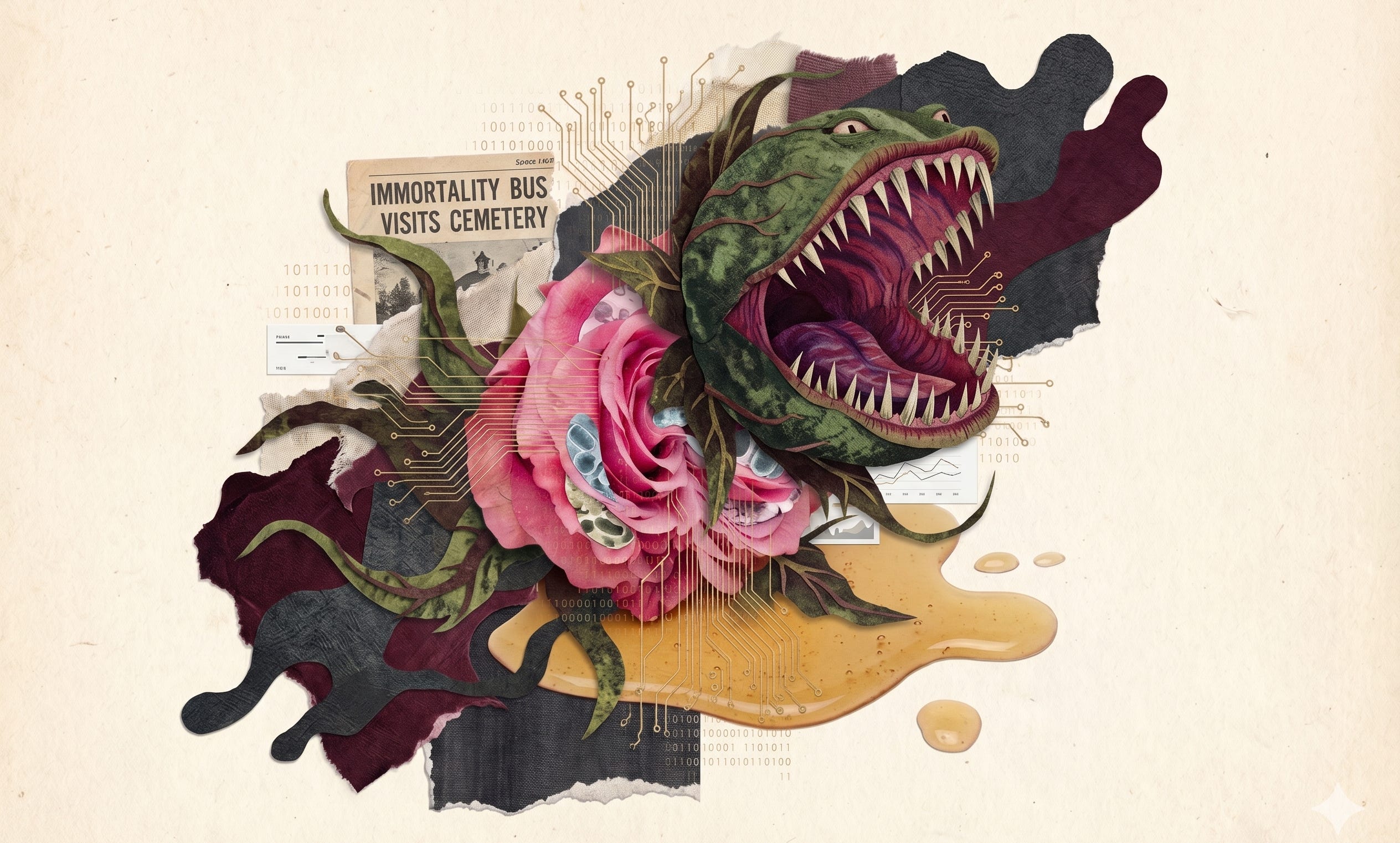
Self-named “immortal” Bryan Johnson recently made the internet extremely uncomfortable. Arguably best known for his vampiric transfusions of his own son’s blood Johnson makes a living out of longevity. Resembling a synthetic from the Alien franchise, Johnson is constantly trying to persuade his audience to sleep more, oh and that he is ageing in reverse. Sure, Bryan. On the last Thursday in April, Johnson posted on the social media platform X the following, “Just gave Kate oral sex. Goodnight everyone.”

It would be presumptuous to assume this was the end of it, as Johnson accompanied the post with the details of Kate’s “vaginal microbiome report” with the claim she scored 100 out of 100. The post rippled through the internet with meme after meme. If the intention was clickbait it worked. Johnson and his partner Kate have a financial interest in the virality of biohacking. Cynically I read the post not as a confessional about their intimate relationship but rather as a barefaced attempt at marketing. But maybe I just don’t find vaginal biomarkers sexy. When skimming Johnson’s summaries of the report I noticed the emergence of a familiar figuration of the sexed body – the female body specifically. Johnson assures us Kate’s sample showed “nothing bad” and “her sample is dominated by the single most protective bacterial species a vagina can host” (Battison, 2026). We can all let out a collective, phew.
Jokes aside, he insists that only “25-30% of reproductive age women globally” have this dominant species and it is “linked to lower risk of BV, UTIs, yeast infections, HPV persistence, HSV-2 and HIV acquisition, preterm birth, and improved IVF outcomes” (Battison, 2026). You can read my piece about pronatalism to understand how transhumanists have stakes in IVF working.

Given women’s health is chronically underfunded, under resourced and under researched the scientific merit of the report is on shaky ground. Whether these types of claims can be derived from a singular sample is hard to determine without specific expertise, but the plausibility of them relies on a socio-cultural figuration of the female body as potentially productive and potentially contagious. So Johnson is reassuring us that it is okay he had oral sex with Kate because Kate’s vagina is viable, not a contaminant. It is easy to see the humour in it, I certainly do, but I also see wider culturally implications. Johnson’s post has the effect of sterilising sex, turning intimacy into qualifiable data. Oddly it reminded me of transhumanist Roen Horn, who I encountered in my research almost a decade ago. Horn was anxious sex with “a real girl” could ruin his chances of living forever (O’Connell, 2017). In revisiting the political campaign Horn was volunteering for at the time he made these comments I uncovered an even stranger story than a giant coffin on wheels.
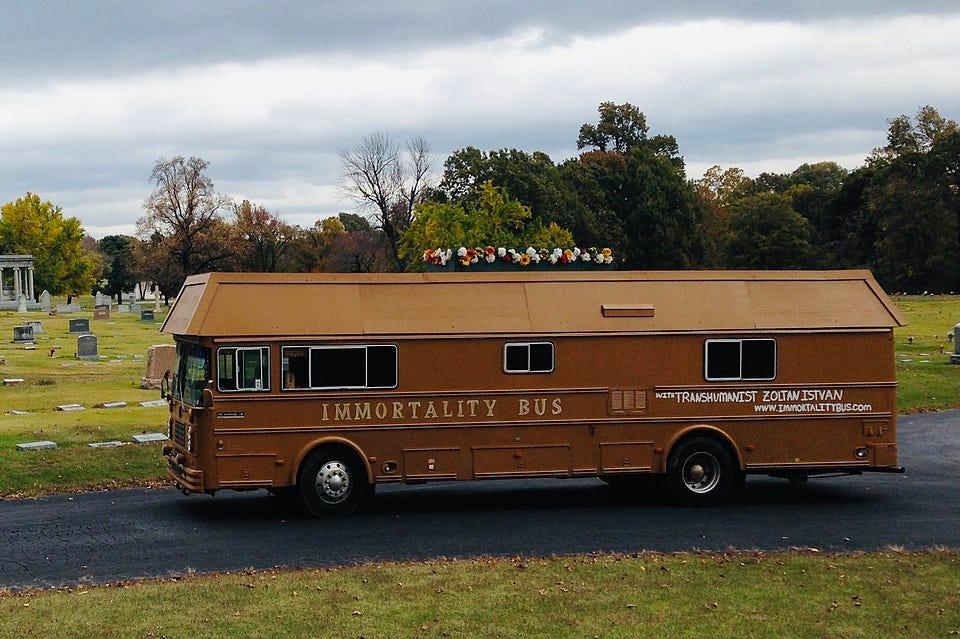
In 2015, in the United States of America, Zoltan Istvan travelled east in a 1978 Wanderlodge designed to resemble a coffin. Not intending to be ironic it had the words “Immortality Bus” sprawled across the side. The tour was orchestrated as part of Istvan’s presidential bid and it caught the attention of the news media, journalists and eventually me. It was obvious from the outset Istvan’s chances of being elected to the highest office had about the same odds as him achieving immortality in his lifetime. Istvan’s ambition was to be a president who would funnel public spending and resources into the precarious pursuit of life extension. The policy he was running on was transhumanism. Previous to his campaign Istvan had self-published the novel The Transhumanist Wager. I have read a lot of transhumanist literature but I couldn’t make it through the first few pages, so to explain the premise I will borrow the descriptions from journalist Mark O’Connell writing for the New York Times. He writes,
The Tranhumanist Wager is “an unwieldy novel of ideas about a freelance philosopher named Jethro Knights who sails around the world to promote the need for life-extension research and winds up establishing a floating libertarian city-state called Transhumania — a regulation-free utopia of tech billionaires and rationalists — from which he wages an atheist holy war on a theocratic United States.” (O’Connell, 2017)
The name “Transhumania” can be attributed to Istvan but the imagining of a libertarian floating city is not an original idea. Even today there are attempts by the billionaire tech elite to make it a reality. Seasteading (as it is known) is being heavily funded and materialising in our waters but I will save further discussion of this capitalistic colonialisation of our seas for another time.
Like Istvan’s presidential campaign the coffin shaped Wanderlodge struggled uphill. For part of the tour O’Connell joined Istvan and his reporting is well worth a read. Also along for the ride was Roen Horn. A steadfast proponent of transhumanism, Horn was volunteering for Istvan’s campaign as well as producing a documentary about the Immortality Bus and I was introduced to him via the YouTube video ‘Atheist Transhumanist Immortality Bus Visits Megachurch in Bible Belt’. Posted on the YouTube account of his Eternal Life Fan Club it can still be viewed today. About halfway through the video, on a gloomy day, the bus pulls into a cemetery. The accompanying music becomes noticeably eery. Istvan and his team exit the bus and as they walk through the cemetery a caption reads “Religious people are the biggest advocates of dying (and the biggest supporters of the multi-billion dollar business of death).” In many of his videos Horn is noticeably agitated by religion, in particular Christianity, so it seems reasonable to presume the caption was his idea. He encourages the viewer to vote for Zoltan Istvan if you want to live forever. O’Connell (2017) describes Istvan as an irrefutably handsome “life-size Ken doll” but I refute. Even the characterisation of him as “proof-of-concept for an Aryan eugenic ideal” seems too generous of description but he is fair haired and muscular. If Istvan is the transhumanist ideal of masculinity it didn’t get him very far politically.
Horn’s appearance contrasts against Istvan, resembling closer to transhumanist Aubrey de Grey (someone Horn holds in high regard). Maintaining a calorie restricted diet, he is thin and wears his dark hair long. Ten years ago Horn attributed his diet to life extension but this is complicated by his controversial past becoming public this year. When talking to O’Connell in 2017 Horn says, “The 20 years I get from eating the way I do could be the difference between my dying and my getting to longevity escape velocity. I’m holding off on pleasure now so that I can have more pleasure later. I’m actually a total hedonist.” At the time the justification of eating less now to eat more over an immortal lifetime was repeated by Horn when he was interviewed about transhumanism. This year a docuseries, Wild Boys: Strangers in Town, revealed there was more to his relationship to food. As a child Horn had been diagnosed with orthorexia, a condition characterised by disordered eating as a result of a fixation on “healthy” eating (Sagar, 2026). Now this is when things are about to take an unexpected turn into the true crime genre.
The docuseries chronicles how in the early noughties Roen Horn, then aged 16, and his older brother Kyle, aged 23, lied to a community in British Columbia. As reported in an article by People, the brothers falsely claimed they had grown up in the woods, prompting the local residents to support them financially and donate free housing until it all unravelled. In actuality Roen and Kyle Horn were from the suburbs of Northern California where they lived with their other siblings and their parents. Ultimately, while living under a lie in British Columbia Roen’s health deteriorated as a result of disordered eating and malnutrition. The brothers were accused of defrauding the community and unable to flee because of his poor health, Roen would be arrested and later hospitalised. By 2016, Roen Horn would be volunteering for Zoltan Istvan and in February 2026 Istvan would post a link to the People article about the “Wild Boys” from his account on X and I clicked.


I had already known of the story of “wild boys”, what I had not known is the connection to transhumanism. Interestingly, as reported by People, Roen says in the docuseries,
“The idea that I could die at any moment — I would have that in the background of my mind too often. It would cause me too much physical stress in my body. I wasn’t channeling the fear right. I just was living with that and feeling like I could do nothing about that vulnerability.”
I have empathy for Roen. There are ethical questions about whether his fear of dying is or was exploited by an imaginary that promises immortality. Or did he find the community of transhumanists a comfort? A safer space for this vulnerability? What I am sure about is travelling to cemeteries on a bus shaped like a coffin is alarmingly symbolic of anxieties about death and dying.
The reason I was initially reminded of Zoltan Istvan and Roen Horn is because in the 2017 NYT article when Horn fails to persuade O’Connell he is a hedonist and the conversation led to sex. Horn expresses how he is looking forward to a future of sexbots; “You know, like A.I. robots that are built for having sex with” (Horn quoted in O’Connell, 2017). One of the problems with “real girls”, in Horn’s estimation is, “You could get an S.T.D. You could maybe even die” so he was abstaining until the sexbots arrive (Horn quoted in O’Connell, 2017). It was this exact quote that I thought of when I read Johnson’s post. The conflation of sex with contagion and ultimately, death.
Writing in the nineteen nineties Sociologist Catherine Waldby (1996) drew on studies from Australia, Britain and the USA to investigate why women and gay men became the targets of AIDS education, while heterosexual men were exempt. Waldby’s research found that women were viewed as guardians of safe sex because they are perceived as more implicated in the flow of infection (Waldby, 1996: 111). As Waldby elaborates, women are assigned to carriers, imagined as lacking boundaries,
“who epidemiological significance relates to their ability to transmit infection between other bodies . . . this lack of boundary is imagined not as a general formlessness but as a capacity for sexual receptivity, for the accommodation of phallic breach of their body boundaries.” (Waldby, 1996: 104)
In other words, from the point of view of epidemiological notions of causality the bodies of gay and bisexual men and women are considered inherently permeable (Waldby, 1996: 104-110). Imagined as fluid and infectious circuits thus implicated in the spread of infection (Waldby, 1996: 110). Waldby (1996: 110) clarifies, at the time the AIDS epidemiology discourse conceptualised the bodies of heterosexual men as impermeable and therefore, not implicated in the causal flow of infection. However it was understood that their bodies were threatened by infection as the potential end point (Waldby, 1996: 110). Connoted in Horn’s fears of being infected with a sexually transmitted disease.
Feminist theorist Elizabeth Grosz elucidates how body fluids attest to the permeability of the body, the perilous division between the inside and outside (Grosz, 1994: 193). Her examination of medical and biological discourse revealed a representation of body fluids from cis men as a solid that can be expelled from the body, for example by washing after sexual intercourse, demarcate their bodies as clean and proper (Grosz, 1994: 201). In contrast to the construction of the female body as an uncontrollable flow, as seeping liquid, the male body, in particular seminal fluid, is primarily understood as what it makes, what it achieves, as a solid. This conceptualisation of the “male seed” is repeated in the logic of pronatalism. Grosz asks whether the reduction of “men’s body fluids to by-products of pleasure and the raw materials of reproduction”, is an effort to separate men from the kind of corporeality attributed to women:
“along with men’s refusal to acknowledge the effects of flows that move through various parts of the body and from the inside out, have to do with men’s attempt to distance themselves from the very kind of corporeality – uncontrollable, excessive, expansive, disruptive, irrational – they have attributed to women?” (Grosz, 1994: 200)
Extreme versions of controlling the body is exemplified by the attempts to biohack the body as I discuss in my previous Substack essay.


Grosz’s hypothesis is, women’s corporeality is inscribed as a mode of seepage, women become figurations of boundless liquidity (Grosz, 1994: 203).
Yet all body fluids attest to the impossibility of the “clean” and “proper”, as they flow, seep, infiltrate, linger and leak out of the body (Grosz, 1994: 193). Therefore, to maintain a certain social order, as Grosz notes, there is a kind of cultural hierarchy of bodily fluids (Grosz, 1994: 195). Different catalogues of control, disgust and revulsion, such as how tears do not have the same association of disgust that the stickiness of menstrual blood can invoke (Grosz, 1994: 195). More significantly she illuminates how “It is not the case that men’s bodily fluids are regarded as polluting and contaminating for women in the same way or to the same extent as women’s are for men” (Grosz, 1994: 197). Grosz uses anthropologist Mary Douglas’s work on pollutions to support this, Douglas states:
“I believe that some pollutions are used as analogies for expressing a general view of the social order. For example, there are beliefs that each sex is a danger to the other through contact with sexual fluids. According to other beliefs, only one sex is endangered by contact with the other, usually males from females, sometimes the reverse. Such patterns of sexual danger can be seen to express symmetry or hierarchy . . . What goes for sex pollution also goes for body pollution.” (Douglas, 1994: 4)
Grosz’s analysis of Douglas’s claim that in certain cultures at certain times the polluting powers of bodily fluids poses a threat from each of the sexes to the other, supports her argument that sexuality had become reinvested with notions of contagion, death, and danger because of the AIDS crisis (Grosz, 1994: 193). It is my belief the assertions by public health discourse that urges women to function as the guardians of the purity of sexual exchange is still relevant today. For example, in 2021 Public Health England made significant changes to The National Chlamydia Screening Programme, removing opportunistically chlamydia screening to asymptomatic men, even while acknowledging chlamydia can lead to significant harm to reproductive health for women and other people with wombs and ovaries. I don’t believe it is the intent of Public Health England’s focus on women to give the message cis men are exempt from the transmission of chlamydia rather it is an effect of this policy change. It is an example of Waldby’s (1996: 10) findings that “As the group exempted from direct address by public health discourse, [heterosexual cis men] are freed from internalising the idea of their bodies as dangerous or infectious, relying instead on the willingness of heterosexual women to undertake such internalisations.”
Positioned as external to the causation of infection “Men seem to refuse to believe that their body fluids are the “contaminants”” (Grosz, 1994: 197). Whereas through multiple associations the female body becomes culturally coding as potentially contagious. As Grosz writes,
“The representation of female sexuality as an uncontainable flow, as seepage associated with what is unclean, coupled with the idea of female sexuality as a vessel a container, a home empty or lacking in itself but fillable from the outside, has enabled men to associate women with infection, with disease, with the idea of festering putrefaction, no longer contained simply in female genitals but at any or all points of the female body.” (Grosz, 1994: 206)
Grosz acknowledges the paradox that the distinction made between a “clean” woman and an “unclean” woman does not come from the inherent polluting properties of female sexuality, but is a function of the quantity and quality of the men she has already been with (Grosz, 1994: 197). “So she is in fact regarded as a kind of sponge or conduit of other men’s “dirt”” (Grosz, 1994: 197). A stigmatisation of women that has not lost its cultural power in the thirty years since Grosz first wrote this. Grosz speculates that perhaps it is the idea that flows can move in two-ways, in indeterminable directions that elicits horror for certain phallicized masculinity, that the possibility of being a passive receptacle is most detestable (Grosz, 1994: 201).
Vagina dentata, Latin for toothed vagina, is a folktale of a woman with a vagina containing teeth that plays on the fears of male castration. It is visualised in the 2007 film Teeth and frequently the monsters we see in horror films and televisions series often resemble fleshy reproductive organs with dripping teeth such as the Demogorgon in Stranger Things. Films are cultural sites that play out heterosexual desires and fears to dramatic effect. The film scholar Barbara Creed (1993) famously conceptualised the Monstrous-Feminine, how in film the female body becomes horrific and associated with death through symbolism and semiotics. Creed writes,
“. . . the myth of vagina dentata is extremely prevalent. Despite local variations, the myth generally states that women are terrifying because they have teeth in their vaginas and that the woman must be tamed or the teeth somehow removed or softened - usually by a hero figure - before intercourse can safely take place.” (Creed, 1993: 2)
Bryan Johnson might not have been looking for teeth but he was seeking reassurance that Kate’s vagina was safe to eat from. This was a twisted story about how the bizarre tendencies of transhumanism reveal more common place socio-cultural anxieties about sex, death and the corporeal body.
Header Image is a photo by Deon Black on Unsplash Edited using Google Gemini
References
Baer, D. (2015) ‘This futuristic presidential candidate is about to drive a giant coffin across America for one unusual reason’ Business Insider. Available at: https://www.businessinsider.com/futurist-presidential-candidate-zoltan-istvan-is-driving-a-giant-coffin-across-america-to-defeat-death-and-win-the-white-house-2015-7
Battison, J. (2026)’Biohacker Bryan Johnson posts partner’s vagina experiment results as it scores top 1%’ LAD Bible. Available at: https://www.ladbible.com/news/science/bryan-johnson-partner-girlfriend-vaginal-test-kate-787761-20260430
Creed, Barbara (1993) The Monstrous-Feminine: Film, Feminism, Psychoanalysis London and New York: Routledge
Douglas, Mary (1966) Purity and Danger London and New York: Routledge
Grosz, E. (1994) Volatile Bodies: Toward a Corporeal Feminism Bloomington and Indianapolis: Indiana University Press
Kristeva, J. (1941) Power of Horror New York: Columbia University Press
O’Connell, M. (2017) ‘600 Miles in a Coffin-Shaped Bus, Campaigning Against Death Itself’ New York Times. Available at: https://www.nytimes.com/2017/02/09/magazine/600-miles-in-a-coffin-shaped-bus-campaigning-against-death-itself.html
Sager, J (2026) ‘Kyle and Roen Horn Claimed They Grew Up in the Wilderness and Found Refuge in a Canadian Town. Then, Their Lies Unraveled’ People Available at: https://people.com/where-are-kyle-and-roen-horn-now-wild-boys-11908899
Waldby, C. (1996) Aids and the Body Politics: Biomedicine and Sexual Difference London: Routledge